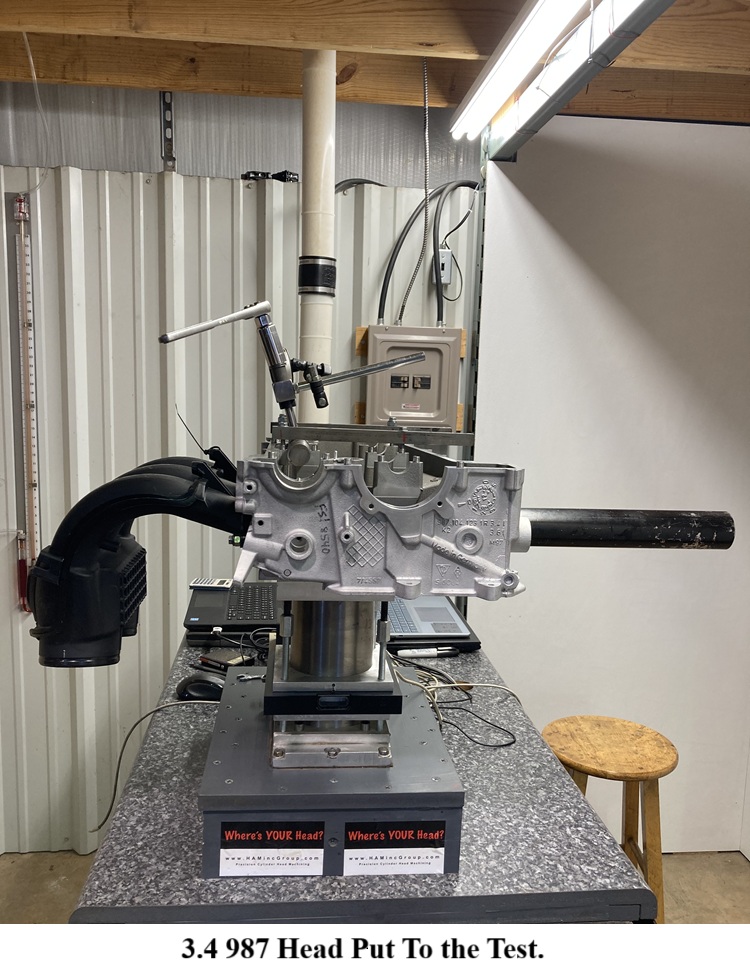

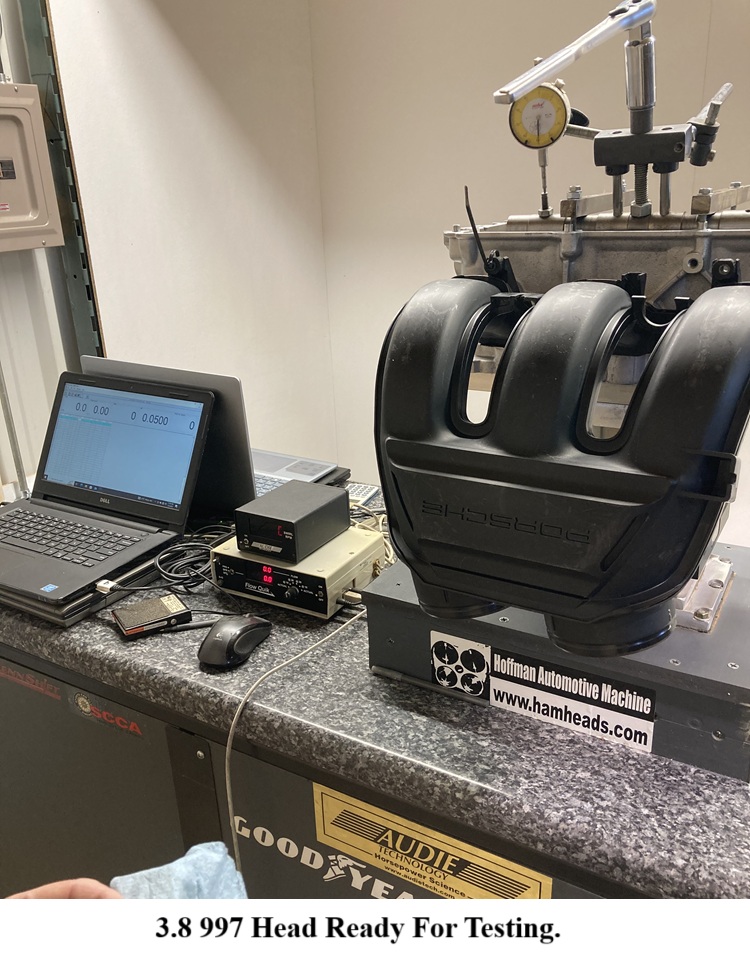
If you’re a gear head reading this post, then you already know about the important roll flow testing plays in the development of cylinder head technology. Intuition informs us that the more air the ports move the more power the engine will make. If only it were that simple. We’d just hog out the ports and cram in the biggest valves we can fit into the combustion chambers. And that would work fine if engines only operated at peak RPM’s at wide open throttle and valves didn’t move up and down through a lift range determined by the camshafts’ profiles, and pressure differentials were consistent rather than variable with piston speed; and if the airflow didn’t have to navigate a circuitous path making its way around moving valves into a cylinder where the rate of pressure recovery is vitally important to performance. Oh yeah, and if it’s a port injected head like M96/97’s, the intake port needs to do all of this without throwing entrained fuel out of suspension.
Using a flowbench to analyze port performance and more importantly predict the head’s impact on the performance of an engine and drivability is a tricky business. With over two decades of flow testing experience, I have learned that raw CFM data, though important, doesn’t tell the complete story. We routinely send flow data to cam grinders and have poured over countless dyno readouts and listened to driver’s feedback. The insights we’ve gained over the years from these relationships is priceless.
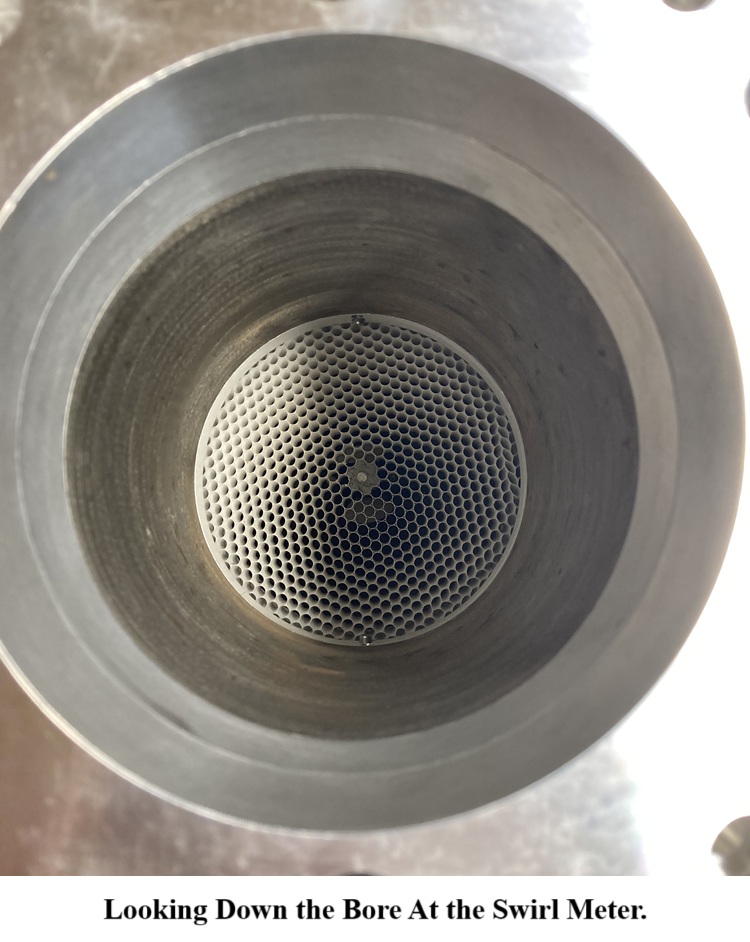
Accepting that raw CFM data isn’t the end-all I’ve been gathering swirl data for years as a way of analyzing how stable air flow is through a port. In four valve heads it also allows me to spot when one valve in a pair is outperforming its neighbor. If flow is identical in a pair of intake valves there is no swirl, only tumble. Swirl often changes throughout the lift range. Also, if laminar flow is inconsistent through the port (localized turbulence) the flow path through the port will change and therefore swirl characteristics, indicating unstable flow. This also can change throughout the lift range. Sometimes compromises must be made to achieve stable flow in the lift points we know to be most important at the expense of less important lift points.
Another largely overlooked method of port analysis is turning a trained ear to the tones coming from the port. A well-functioning port will have a smooth even tone at a given lift point. A port with unstable flow will have fluctuating tones. Like the swirl characteristics tone consistency sometimes varies through the lift range. A port that sounds great at peak lift might sing a different tune in the super critical mid-lift range. We often see this when valve size exceeds the optimum dimensions for the port size and shape. Four valve heads suffer greatly from valve crowding when valve size passes the optimum. With M96/97 heads there are hard limits to this due primarily to valve spacing.
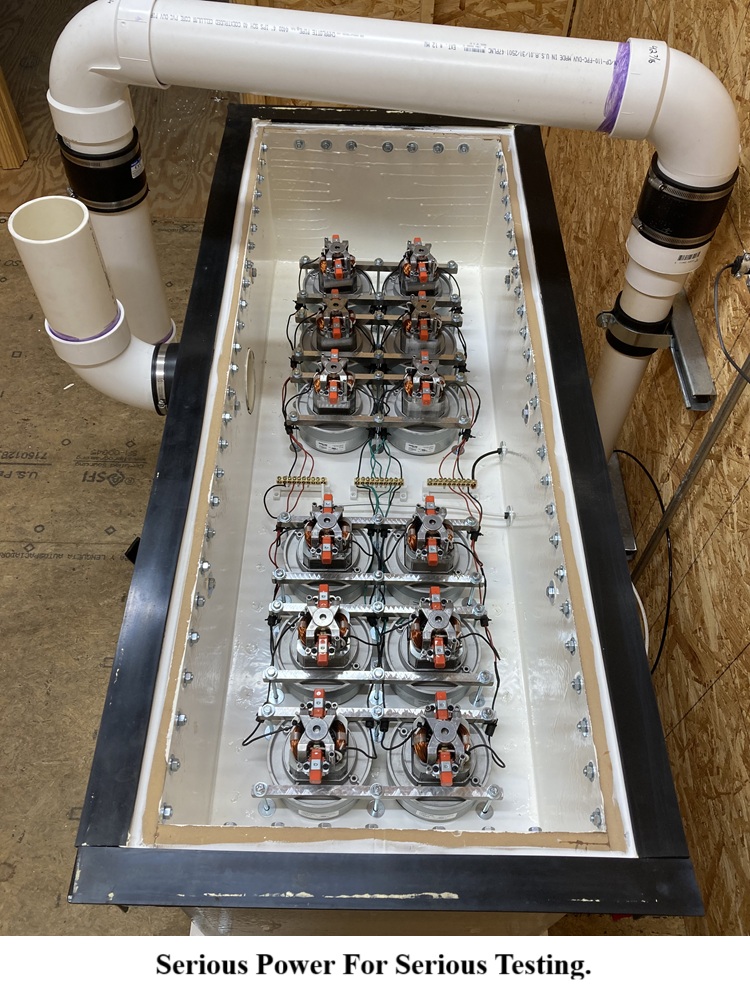
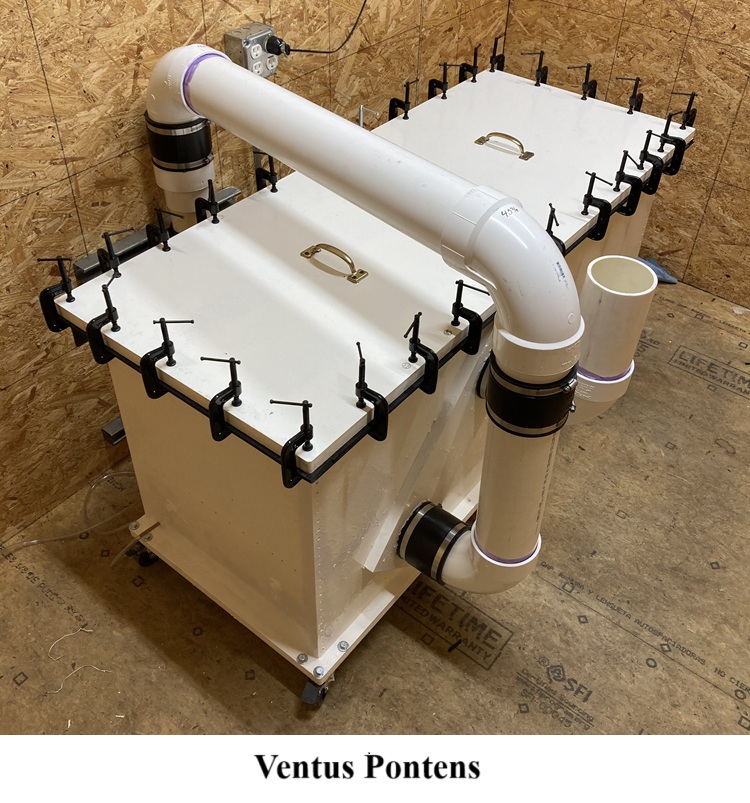
This brings me to the introduction of our latest flowbench design. My desire to get a clearer, less cluttered sound from out ports led me to design a remote blower unit for our bench. The universal design concept of our custom flowbench has allowed us to utilize different remotely positioned blower types over the years. For the past few years, I had a centrifugal blower coupled to a ten H.P. electric motor that sat proximal to our bench and moved an insane amount of air, but it was loud and made analyzing port tone a challenge.
For the new blower I utilized our CAD software to design a multi-compartment cabinet and had the panels CNC cut by a local woodworker from 1″ MDF. I collaborated closely with Audi Technology and the new arrangement takes advantage of their state-of-the-art depression controller and of course their fantastic data acquisition hardware and software which we’ve been using for over twenty years at the time of this writing. Our finished unit is extremely powerful and capable of tremendous depressions at high CFM rates. And best of all; with it upstairs I can’t hear it when I’m conducting a test.